Poe Dameron: Dashing Resistance operative. One hell of a pilot. LGBT cinematic icon?
I'm a gay Star Wars fan, and this blog is my effort to collect and contribute to musings about LGBT characters in sci-fi, geek culture, and beyond. Welcome!
Submitted for your consideration: a short interview of Oscar Isaac from Collider at a premiere of X-Men: Apocalypse, and his answer at 1:00 about the rumors of Poe's romantic entanglements in Star Wars. It's either some very charm-soaked poemosexual affirmation or some really evil baiting.
But even if it's baiting, it's easy to forgive if you pretend, when he looks directly into the camera, that he's winking and flirting with me. I mean, with you. As in, with a hypothetical audience member.
Is it hot in here or is he just melting metal with his mind?
Sadly, last night's episode of Marvel's Agents of S.H.I.E.L.D. seemed to diminish expectations that its muy caliente first openly gay character, Joey Gutierrez, would be a major player in the series going forward.
The Marvel Cinematic Universe introduced Joey in last fall's Season 3 premiere. We didn't really find out that Joey is gay until a few episodes later, when a former boyfriend came up in dialogue. And when we did find out, I was really excited that it was revealed (as it should be) as simply a trait of a three-dimensional character with realistic flaws and authentic motivations. A non-exploitive gay hero in a mainstream franchise, yay!
Up through the mid-season haitus, Joey played minor but key roles in the narrative as one of the many new Inhumans that were transformed by the release of Terrigen into the world's oceans at the end of Season 2. The evolution of Joey's initial ambivalence regarding his new powers into growing acceptance was a nicely done story line, with an overt parallel drawn to the process of coming out and the freedom and power of self-actualization. In the mid-season finale, Joey surprised even himself by risking his own life to save Daisy, and a hero was born. I was really excited see his further growth when the season resumed last night.
Unfortunately, last night's mid-season premiere put a damper on those hopes when Joey was given an Apple watch with a S.H.I.E.L.D. screen background and sent home to have dinner with his mother. Or something. It's a plan cooked up by Daisy and Director Mack to give Joey and the other Inhuman Secret Warriors some generous telecommuting benefits and allow them to carry on their former lives while still being on call as S.H.I.E.L.D. operatives.
The upshot is that I expect large gaps in Joey's onscreen time while he's away eating his mother's home cooking. I hope I'm wrong, but we might not see the MCU's single gay character again until closer to the Season 3 climax. Free Joey!
To recap: gay characters in mainstream pop culture, especially in geek culture, are generally either psychopathic villains or buffoonish clowns who provide comic relief. These tropes have become so entrenched that many audience members react strongly and negatively when challenged with LGBT characters in other roles.
And especially when it comes to gay male heroes: all the stereotypes about gay male effeminacy and mental disorder tend to fuel misguided assumptions that homosexuality--and especially homosexuality in men--is incongruent with the kind of charismatic heroism that central protagonist roles usually demand. I believe that this is a big part of the resistance to Poe being gay: audiences just can't reconcile a gay male heroic character with societal stereotypes of gay men as sissies and wimps.
So I thought it was worth a little primer (or reminder) on a few real-life gay men who challenged the poisonous misconceptions that homosexuality somehow prevents a man from cutting a heroic figure. This is just a tiny sample of gay men whose high-profile selfless acts of heroism saved lives--often at the expense of their own.
Sipple (left) saves the life of Pres. Ford by
grabbing Sarah Jane Moore
Oliver Sipple was a gay man who served as a Marine in the Vietnam War. On September 22, 1975, Sipple thwarted an assassination attempt of President Gerald Ford in San Francisco by grabbing the arm of the would-be assassin, Sara Jane Moore, as she raised her gun to fire. The bullet missed the President and struck an innocent bystander, who suffered only minor wounds. Sipple was declared a hero for his bravery and quick action.
Unfortunately, this unwanted fame thrust him into a spotlight that outed him to his family and society, leaving him alienated and embittered until his death in 1989. But Harvey Milk, a San Francisco city supervisor and the first openly gay elected official in the U.S., knew Sipple and wanted people to know that Sipple was gay. Milk is quoted as saying, "For once we can show that gays do heroic things."
Staff Sergeant Eric Alva was the first American Marine to be wounded in Iraq in 2003, and the Iraq War's first recipient of the Purple Heart. On the first day of Operation Iraqi Freedom, Alva stepped on a landmine and sustained injuries that required amputation of his leg.
After his injury, Alva worked to improve the opportunities of other gay people who wanted to serve, and he became a spokesperson against the U.S. military's "Don't Ask Don't Tell" policy until it was finally repealed in 2011. Alva is quoted as saying: "I joined the military because I wanted to serve. I was patriotic, idealistic; I was also gay."
....Hm. Latino, patriotic, idealistic, gay. He reminds me of someone... I can't quite put my finger on it... Oh, and if you're having a hard time imagining what a dashing, decorated, gay military fighter pilot might look like in real life, behold: Lt. Col. Victor Fehrenbach.
Not so bad, right?
Allan Fonsecawas a Macy's employee who was working the day of the Clackamas, Oregon mall shooting in 2012. When Fonseca heard the gunfire, he led a customer out of the store, then had the stones to go back in--TWICE--to help more customers and coworkers evacuate.
So gay heroes are not just soldiers. They're civilians too. And sometimes they have gorgeous skin and work at the Lancome counter. Deal with it.
Tori Johnson was another civilian hero that helped others survive a crazed gunman in Sydney in December 2014. The gunman took a dozen people hostage in a cafe and used them as human shields during an hours-long standoff with authorities.
Eventually, Johnson, a gay man and the manager of the cafe, charged the gunman and tried to wrestle away the weapon. Johnson was fatally shot, but his selfless actions distracted the gunman long enough for the others to escape, and the gunfire brought in the police, who killed the gunman. The entire country of Australia remembers him as a hero.
The horrible events of September 11, 2001, marked some of our country's darkest hours. But on that terrible day, the heroism of emergency responders and of everyday people inspired the country and captured our imaginations. Two of the most widely-known heroes of September 11 were gay men.
Father Mychal Judge, known as the Saint of 9/11, was a Franciscan Chaplain to the New York Fire Department and had the dubious honor of being the first victim of the September 11 terrorist attacks when he was killed by falling debris. His heroism and bravery at the World Trade Center were extraordinary, but his full story as an out, gay, recovering alcoholic Irish-Catholic priest is nothing short of legendary. Judge's spirit, kindness, and charisma touched hundreds, if not thousands, of lives. His was a terrible loss, but like all heroes, he made his sacrifice with courage and selflessness and he was a credit to all Americans.
Mark Bingham was an entrepreneur, a skilled rugby player, and a gay man from the Bay Area who found himself on board United Flight 93 en route to San Francisco on September 11. When the flight was hijacked, Bingham was one of the passengers who stormed the cockpit to prevent the terrorists from completing their attack, sacrificing themselves in the ensuing crash to save countless other lives. His and the other Flight 93 passengers' stirring tale of heroism is memorialized in numerous films and documentaries. Bingham is remembered by the Bay Area and the broader gay community as one of the largest-looming heroes of 9/11.
These men (and countless other LGBT people, men and women alike) are exactly the type of hero that has never--ever--been portrayed in a sci fi or action film as a main protagonist, even though their heroics capture the selflessness and bravery that we all admire in a character like Poe.
And the next time someone scoffs at the idea of Poe (or any central protagonist) being LGBT, with the implication that someone as heroic, charismatic, and virtuous as Poe couldn't possibly be gay, keep these men and their stories in mind.
Vanity Fair published a terrific article describing how Deadpool's box office success puts it in a great position to eventually introduce--in the greenlit sequel--the first openly male LGBT hero in a comic book film.
The initiative and willingness from the creative side is definitely there. The comic books have numerous references to Deadpool's omnisexual flirtations, which make it harder for closed-minded audiences to burden a queer film adaptation with the whole "diversity for diversity's sake" garbage. And more specifically, Tim Miller, the film's director, described Deadpool as pansexual, and Ryan Reynolds has previously remarked that depicting Deadpool in the future with a boyfriend "would be great."
But more importantly, the dollar signs are there. As mentioned previously, one of the major studio concerns with LGBT central protagonists is China's restrictive cultural policies that censor or ban positive images of LGBT people in media. China is a huge consumer of U.S. films, so jeopardizing a film's success there with an LGBT main character makes major studios skittish.
Deadpool was banned in China for violence and sexuality, but Fox still made PILES OF MONEY in opening weekend. According to Box Office Mojo, Deadpool had a staggering $150 million opening four day domestic weekend, with a $264.8 million worldwide debut as of last Sunday. This makes Deadpool Fox's biggest opening weekend ever (beating second best Episode III: Revenge of the Sith's domestic opening by about $25 million).
So basically? China's anti-gay media policies can suck it.
I really hope this emboldens Fox to make Deadpool's bisexuality a more meaningful character trait in the sequel, as opposed to just making it a part of the humor. And if that happens, we would have the first cinematic LGBT hero in a comic book film. And in turn, I hope that Disney/Lucasfilm is emboldened to consider an LGBT heroic main character for the cinematic Star Wars franchise.
When a former co-worker shows up at the office holiday party to stir shit.
Battlestar Galactica, that stalwart old ship, has been cruising into fandom's consciousness quite a bit in the past week or so, with an announcement of movement towards a cinematic adaptation at Universal and Alessandro Juliani (Lt. Felix Gaeta from SyFy's rebooted BSG) popping up on the new X-Files series. So although I've been thinking a lot about BSG in relation to LGBT characters in sci-fi the past couple of months, this seemed like a good time to write about it.
I was six years old when the original BSG aired on television, and I was smitten. It was like Star Wars, but it was on TV every week so I could regularly get my fix of cool ships, weird aliens, and soapy space drama. I admittedly had a little schoolboy crush on Dirk Benedict's Starbuck, but mostly I was just there for the Viper dogfights and the shiny kick-ass Cylons.
When SyFy reimagined BSG in 2004, it quickly became apparent that BSG had grown up in the intervening quarter century. The stories were profoundly political, philosophical, complicated, and ambivalent. The design was gorgeous and the cinematography revolutionized that photojournalistic zoom-in style we now see in all sorts of sci-fi today (see, e.g., The Expanse). The performances were uniformly terrific, and sometimes just brilliant--every moment in the romance between Mary McDonnell's President Roslin and Edward James Olmos's Admiral Adama was understated, soaring, heartbreaking, and simply glorious.
Unfortunately, the series finale was pretty infuriating, and, like Lost, did not do justice to the nuance and ambiguity of the series. I remember people referring to it as "Bible-star Galactica": seriously, the implication that Starbuck was a goddamn angel made all of us at our viewing party lunge for the same coffee table to flip. Outrageous.
And speaking of ambivalence, the other aspect of SyFy's BSG that continues to perplex and confound me is its inclusion of LGBT characters.
In general, the humanoid Cylon models (at least the female ones) were sort of pansexual, especially the Sixes, played by Tricia Helfer. There was a threeway reference in Season 3 involving one of those randy Sixes, a Three (played by lesbian super-icon Lucy Lawless), and Gaius Baltar. But while this indicates the fluid sexuality of the Cylons, it was basically gratuitous set decoration.
The Pegasus was capable of FTL (Faster Than Lesbianism) speed.
The TV movie Battlestar Galactica: Razor achieved a deeper exploration of gay main characters when it revealed that the captain of the Battlestar Pegasus, Admiral Helena Cain, was in a relationship with a Number Six model named Gina. The destruction of the colonies drives Admiral Cain mad with vengeance, and when Cain discovers that Gina is a Cylon, things do not end well. What follows is a classic BSG meditation on the ironic/tragic way that leaders obliterate life and humanity to protect life and humanity. Unfortunately, the story doesn't really break any new ground for LGBT characters. Cain becomes a psychopathic villain who is ultimately destroyed, a very well-trod cautionary tale story line for LGBT characters in sci-fi and otherwise.
That look: I'm getting multiple GAY-DIS contacts, sir.
Then, in the midseason break of the final season, Battlestar Galactica: The Face of the Enemy was released as a series of short webisodes with long-time central character, Felix Gaeta (Gay-ta? come on), as its main protagonist. In the first webisode of The Face of the Enemy, we see Gaeta share an on-screen kiss and a very sweet moment with Louis Hoshi--and it seemed like BSG was going to give us a gay male hero who could have his own side-adventure and get his guy, too!
Alas, four major issues ultimately left The Face of the Enemy as a less-than-ideal introduction of an LGBT hero:
Through a series of flashbacks, we learn that Gaeta was romantically involved with an Eight, a Cylon female model. So Gaeta is technically bi, which is great (and kind of even hotter). But a part of me can't help but wonder if that was some sort of assurance from the writers to the straight audience members who might not appreciate bisexuality as a legitimate thing that, yes, Gaeta was gay with Hoshi, but he wasn't that gay, only kind of gay sometimes, so he could still be taken seriously as a male protagonist. The romantic entanglement with the female Eight, while important to the plot and certainly not gratuitous, still feels to me a little like a concession.
The only mention that Gaeta is LGBT is in those 33 minutes of webisodes; it never came up at all before or after in any of the SyFy broadcast episodes. Casual viewers of the TV series could have gone the entire show without ever knowing that Gaeta was LGBT. There was suspiciously little audience reaction, which suggests that this canon content slipped by pretty much under everyone's DRADIS. So Gaeta is not exactly the out and proud LGBT hero we're looking for, and it leaves an impression of classic LGBT tokenism in sci-fi content: "Aren't we edgy for having a gay male protagonist in a mainstream sci fi property?! But to be safe we'll just do it over here in this little non-essential side project and shh don't tell anyone, 'kay?" Meh.
Gaeta's and Hoshi's romantic storyline goes out with a whimper. Hoshi spends his on-screen time doing awesome boyfriend stuff for Gaeta--smuggling him drugs, persuading Tigh to authorize a fool's errand of a search-and-rescue mission, actually volunteering for said fool's errand search-and-rescue mission, sweetly assuring Gaeta that "Baby, you're good!" when they finally find him, and later holding Gaeta's hand as Gaeta is wheeled away on a gurney to receive medical attention, never leaving his side. So how does Gaeta repay all this concern and devotion? As soon as he's back on his one good foot, he promptly dumps Hoshi. I mean... dude. I know the events on the Raptor were traumatizing but the relationship seems unnaturally easy for Gaeta to simply terminate--he assures Hoshi that he will try to protect him because Hoshi searched for and saved him, but not because they've been fraking each other for gods' sake. Gaeta treats it like some sort of debt, and not even a debt of any particular gratitude. It's a really unsatisfying moment and feels like a contrived way to avoid having to carry the relationship through to the televised episodes.
Although largely an enigmatic everyman throughout the series, Gaeta was consistently moral and steadfast, which was why I was so pleased to have him introduced as LGBT. But the events that unfold while Gaeta is stranded in the Raptor with the treacherous Eight leave Gaeta in a very dark place of self-revulsion and regret, and spark his motivation to mutiny against Adama and his alliance with the Cylons in the subsequent SyFy episodes. And in the morally murky BSG universe, consistent convictions get people into serious trouble, so Gaeta's unwavering beliefs lead him to an untimely demise several episodes from the series finale. So... yep. The story manages to turn Gaeta into yet another LGBT antagonist who gets killed before the end. *sigh*
Don't get me wrong here. SyFy's BSG is one of my favorite sci-fi TV series ever. And I really enjoyed The Face of the Enemy--it won Streamy awards in 2009 for Best Dramatic Series, Best Male Actor/Dramatic, and Best Writing/Dramatic, so it was kind of a big deal in terms of web-exclusive quality and impact. Kudos to the BSG producers, writers, and cast for finally showing a gayprotagonist in a sci-fi series at all, especially a protagonist as (mostly) heroic and nuanced and sustained as Gaeta was.
But that's not to say that we can't do better. BSG got close, but there's more we can do in terms of decoupling the seemingly inevitable association of homosexual characters with disease, tragedy, and misery in sci-fi portrayals.
*cough* Poe *cough*
And now, here's some of my favorite BSG eye candy because I'm a sharer.
Jamie Bamber. He sure knows how to ride a Viper.
Michael Trucco. "Space athlete" pretty much checks all the boxes, amirite ladies?
Just a quick disclaimer: The point of this blog is not really to ship Finn/Poe, although that's naturally going to come up if we're discussing the possibility of the first gay hero in the Star Wars cinematic universe. It's cool if Finn is not straight too, I just didn't get it from Finn's character in the movie the same way you see it in Poe. Finn is so desperate and panicked throughout TFA, romance does not really seem like it's on his radar at all.
A full-on LGBT relationship would be amazing, but I would be happy if Poe were gay, with or without a romance. Okay, that said:
I found faerielion's tumblr, and there's a post from January 4 that does a side-by-side comparison of how the Han and Leia theme plays over the Finn/Poe reunion scene. And since Han and Leia are the central romantic pair from the OT, their theme is basically the Star Wars love theme.
Here's how it works:
*heart eyes*
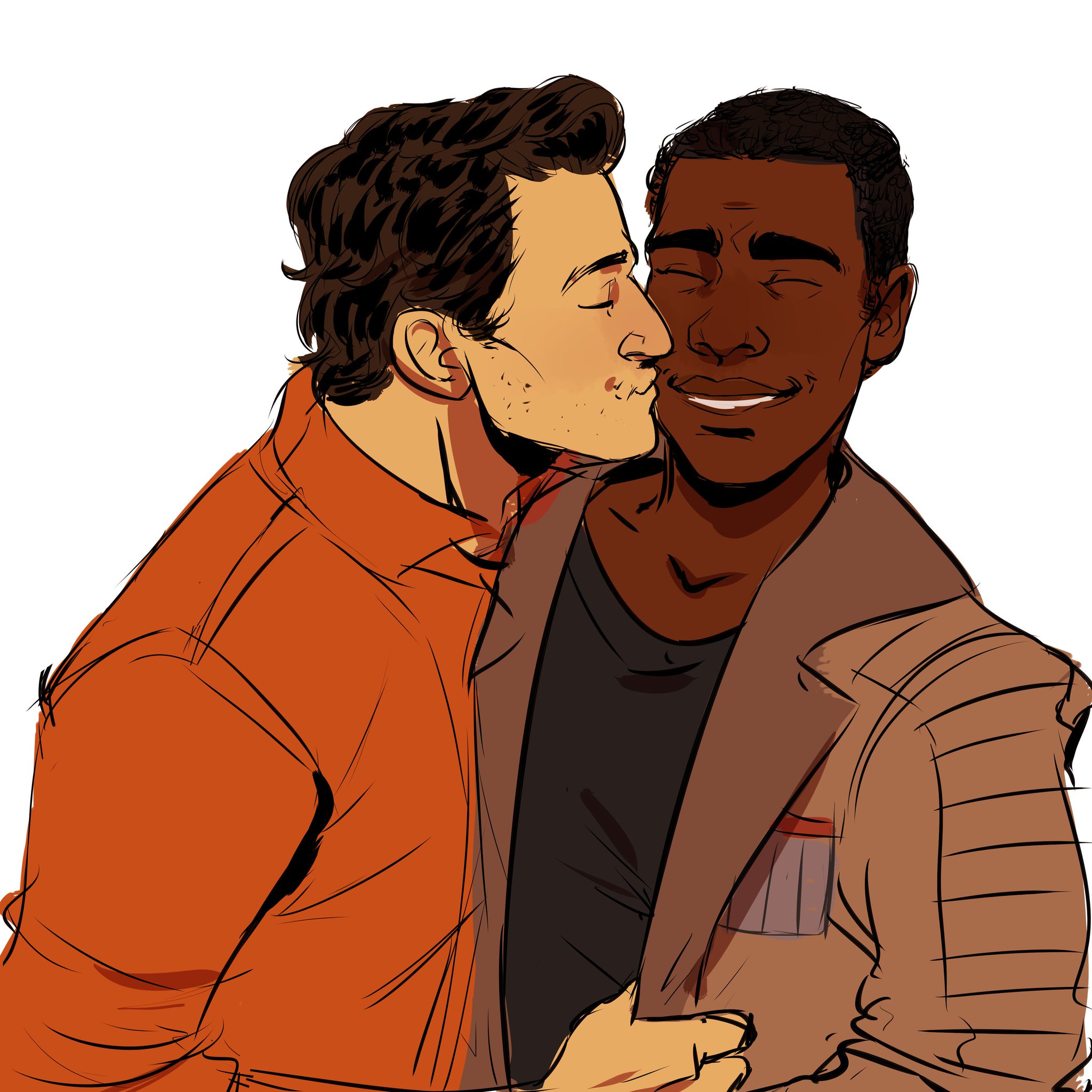
fan art by rngrn
Step 1: Play the Han and Leia theme, and note the lovely woodwind melody at about 1:55 that is repeated with horns at 2:15.
Step 2: Now watch the scene where Finn and Poe are reunited. That same woodwind theme from the Han and Leia orchestration starts at about 0:24 seconds when Poe is greeting BB-8, and (OMG) the horn theme swells just as Poe and Finn are jumping into each other's arms.
Step 3: Feel all the feels.
Now, by TFA, Han and Leia are no longer romantically in love, and I imagine that when Williams was composing this piece for the TFA soundtrack, he was thinking of a very mature relationship--powerful feelings, for sure, but not sexy-fun-times. So I'm not sure that using that melody from the Han and Leia theme was necessarily meant to suggest romance, as much as just a very warm and emotional moment for the characters of Poe and Finn.
At the same time, wow. Those are some very intense emotions for two guys to have for each other after probably no more than an hour together during their escape. And it all goes downhill moments later with the lip bite...
Don't judge me too harshly, but I just recently finished Chuck Wendig's Star Wars: Aftermath (tagline: The War Is Not Poe-ver). As everyone obviously already knows, this book is a big deal because it introduces us to the first gay male hero in Star Wars: Sinjir Rath Velus.
Just so I get this timeline right--the first LGBT Star Wars character was technically Juhani from BioWare's Knights of the Old Republic, and she appeared well over a decade ago. Juhani was a lesbian Cathar who had an optional romance subplot with female player-characters.
(And I guess if I'm talking about that, I should also mention that same-gender romances were available in later expansions of BioWare's Star Wars: The Old Republic MMO. My Sith Marauder was so Force-grabby with that Theron Shan! Made me blush, honestly.)
Then, lesbian Imperial Moff Delian Mors turned up as a villainous antagonist in Paul S. Kemp's novel, Lords of the Sith, released in April 2015 (and no, I haven't yet read that but I intend to... someday?).
Finally, last fall, Wendig went big with LGBT characters in Aftermath. In addition to Sinjir, there's a fleeting but heartbreaking mention of a war orphan's deceased gay dads in a side-story interlude set on Naboo. And another main character, Norra, has a lesbian sister, Esmelle. She and her wife, Shireen, share several scenes with the protagonists and are well-conceived characters in their own right, although not really central to the plot.
Dead-on Sinjir fan art by makeramidying
But Aftermath really makes a big gay jump to rainbow-streaming lightspeed with Sinjir Rath Velus, the Imperial defector. No question, a cinematic version of Sinjir would pass the Vito Russo test as an overtly gay three-dimensional character who is integral to the narrative: he is our first LGBT hero in Star Wars storytelling media.
...Sort of.
Sinjir has serious substance abuse issues. He is an Imperial deserter who kind of remorselessly admits to being "a bad man." In his prior life as an Imperial Loyalty Officer, he was responsible for conducting witch hunts to ferret out un-Imperial conduct in the Empire's ranks. The novel is pretty explicit about Sinjir's chilling ruthlessness in capturing, interrogating, torturing, and punishing offenders. He is unapologetic in his self-interest and, for most of the novel, it appears likely that he will somehow betray his comrades. He is judgmental, narcissistic, and largely indifferent to suffering.
But Sinjir works as a compelling protagonist because Wendig balances those dire character flaws with interesting and authentic positive attributes. Sinjir realistically struggles with a profound crisis of conscience, not unlike Finn's at the beginning of TFA. Sinjir seems sincere when he hints at wanting to "do better," and when his loyalty is ultimately tested, Sinjir's nascent better nature prevails. Not to mention, when it comes to action sequences, Sinjir is a fucking ninja (which is obviously the finest attribute a character can have, as far as I'm concerned).
To sum up, Sinjir is not really our first LGBT Star Wars hero. Sinjir is our first LGBT Star Wars antihero.
I had mixed reactions to Sinjir being so complicated and messy. A part of me was disappointed, and was like, "Really? The one gay guy has to be a raging alcoholic and a treacherous war criminal?" It's almost as if portraying Sinjir as a classic hero was too far-fetched--he had to be seriously flawed so he would "make sense" to a straight audience who would view homosexuality as entirely incompatible with heroic virtue.
My other reaction was, well, why not? Aren't antiheroes more interesting and more fun as characters anyway? But more importantly, I started to see this as a evolutionary arc, as if Lucasfilm is priming the pump for the inevitable widening inclusion of gay people in Star Wars stories--maybe even movies. Stick with me here:
They started off pandering to the all-too-familiar trope of the villainous homosexual with Moff Mors. Plus, Mors is a lesbian, and therefore is less threatening to straight men's concepts of masculinity. Thus, Moff Mors is well within the audience's comfort zone.
Then, the franchise ramps up the challenge to introduce Sinjir, a gay male protagonist, but who still retains the trappings of the familiar homosexual villain. In that sense, Sinjir is like a transition phase for a homophobic audience, blending comfortable stereotypes with a preview of what's in store.
The final step in the process would be Poe. As a gay male, he would be a more direct and serious challenge to cultural assumptions of masculinity. And he would be a no-holds-barred virtuous hero whose sexual orientation exists harmoniously with his goodness and valor.
I know. I can't even take seriously my own suggestion that Lucasfilm producers have some secret blueprint for gradually introducing gay Star Wars characters. But at the same time, as Chuck Wendig heroically and hilariously ranted on his blog in response to the vile reactions to Sinjir, TFA, and anything else not white and straight and male in Star Wars:
Nice thing with Star Wars is, it is happening. Look at the protagonists of The Force Awakens. Look at Lucasfilm. They’re openly committing to finding a woman director for Star Wars. Kathleen Kennedy notes: “Fifty percent of our executive team are women. Six out of eight of the people in my Story Group are women. I think it’s making a huge difference in the kind of stories we’re trying to tell.” Some of the story group are also people of color. It’s a start. Especially when it’s starting in one of the biggest SFF franchises ever. Perfect? No. Nothing is. But it’s nice to see changes happening. It’s nice to see some equity there between the audience that consumes this stuff and the people who make it. Stories matter to people. Characters matter. Creation matters. Nobody should be excluded. Inclusion is awesome.
And if you oppose that — you know, hey, fuck you. Go on and throw pebbles at mountains. Go on and boycott the sun. Let me know how that works out for you.
Meanwhile, I’m gonna be over here enjoying what’s to come. I suggest trying it. Loving stuff instead of hating it. Accepting the world as it is, not the world as you mistakenly hope it will be.
Sinjir has grown on me. He is a terrific LGBT antihero and I can't wait to see what he does in Wendig's sequels to Aftermath. I am thrilled to have him in the Star Wars universe--it is much better (and much much sassier) for his inclusion.
And if they weren't separated by a generation, I'd totally ship SinPoe. Right? Opposites attract!
This passage from today's Comics Alliance article by Andrew Wheeler is just spot on:
Still, I cross my fingers and wish for a gay hero like Poe Dameron; for the kids he could inspire, and even the adults who never had that, and whose confidence could use a boost. But wishing won’t make it happen. It’s up to companies like Marvel and Lucasfilm, and their parent company Disney, to acknowledge and accept that same-sex relationships deserve to exist in their worlds.
Maybe this time it’s real, and we exist, and we matter. Maybe Poe Dameron is our hero.
Wheeler makes the fair point that Poe was not originally scripted to survive TFA's first act, much less be gay. Nevertheless, the synergy between Isaac's charismatic performance and the surge of positive fan response could be capitalized upon and incorporated into Ep. VIII script revisions...
... if it wasn't for the Poe Dameron comic that comes out in just a couple of months. *sad trombone*
If it's true that Poe was not originally conceived as a gay character, is there reference to Poe's orientation built into the comic plot? If so, can Marvel feasibly accommodate a shift in Poe's character from straight to gay? Would they even if they could?
It'd be a shame if there was a consensus between the fans and the creative team to change Poe's character, but timelines and production schedules made it impracticable.
The Hollywood Reporter announced today that the R-rated Deadpool has been banned by China's media regulator. Although film studios often edit films to accommodate China's policies, apparently Deadpool is just too sexy and bloody to edit out the offending material without altering the plot (yay! :D ). There are no plans to adjust the film to screen it for audiences in China.
I find this really interesting. Marvel is owned, just like you and me, by Disney, and 20th Century Fox produced Deadpool. In effect, this is the exact same media/entertainment team that brings us the Star Wars franchise.
Remember The Telegraph article that discussed the big financial stakes involved if China, the world's second largest film market, bans a film, say, for containing a gay character that is portrayed in a positive light? Maybe this is an indication that Disney and Fox will not necessarily put the breaks on a major property film just because it won't play in China.
Also, get this. The Force Awakens opened two weeks ago in China on January 9, but it was only the 20th biggest opening weekend box office for a film in China, as opposed the number 1 biggest opening weekend film in the U.S. Also, in the U.S., the box office dropped 33% after the first week, and another 51% after the New Year. In China? The box office dropped 61.3% after just one week.
So Star Wars, while still huge in China, certainly doesn't have the same momentum there as other cinematic classics like Transformers: Age of Extinction (lol wut?). The box office takings would be diminished by China banning Episode VIII, no doubt, but would it really be enough to not tell a good story that's worth telling? Let's see what happens with the Deadpool numbers.
I'm no box office analyst, but if I was a studio exec deciding whether to take a risk on including content that might get a Star Wars film banned in China, I might say, "Fuck it, make that helluva pilot a helluva homo!"
Check out @GayHotDameron on Twitter. It's Poe tweeting about his misadventures in flirting into and out of trouble, sorting through his powerful but confusing feelings for his "buddy" Finn, and generally being a well-intentioned knucklehead. Very cute.
I’m not a pin-up boy. Sure I do pictures for the Resistance but a guy’s gotta earn a living, right? And I am hot. It would be a waste not to
Remember when I went on and on about the Wachowskis and rhapsodized about how much their films mean to me as a gay science fiction fan? Jupiter Ascending managed to sweep up a bunch of Razzie nominations last week: Worst Actor (Channing Tatum), Worst Supporting Actor (Eddie Redmayne), Worst Actress (Mila Kunis), Worst Directors, Worst Picture, and Worst Screenplay. Holy Wach-OUCH-skis! That's pretty bad, although I submit that Kunis and Tatum should have also been nominated for Worst Screen Combo. Seriously, there's more chemistry involved in paint drying than between those two.
"A Razzie? Well fuck you very much."
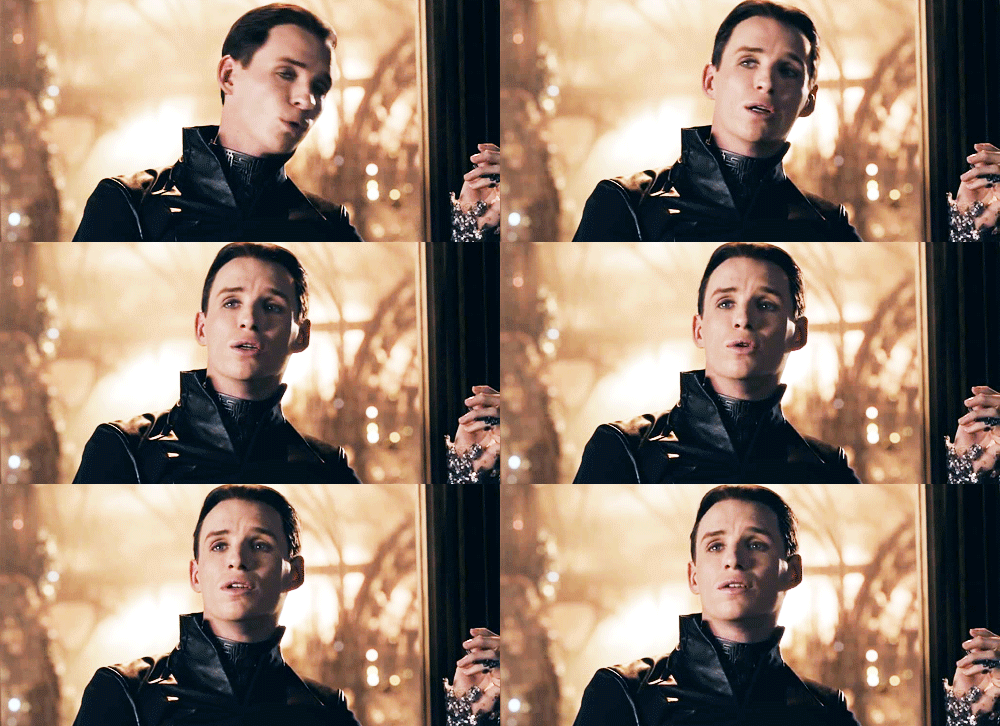
I do take issue with Eddie Redmayne being a "worst" actor. In 1977, Sir Alec Guiness delivered with commitment, style, and charisma stultifying dialogue like "He feared you might follow old Obi-Wan on some damn fool idealistic crusade like your father did," and "Now, that's a name I've not heard in a long time... A long time." And he was nominated for an Oscar for BEST supporting actor in Star Wars. (Peter Cushing and other actors of that generation were the same: it didn't matter if they were in the cheesiest science fiction schlock acting on sets with paper mache boulders. Every line was delivered with the same care and drama as if it were Shakespeare.) Redmayne did the same thing in Jupiter Ascending. Sure, he spent much of the movie flying into inexplicable rages, posing and hissing and sparkling like a drag queen who is just done with your bullshit. And maybe the reason so much of the final cut's set pieces were digital was because Redmayne chewed up and swallowed all of the original scenery. But I thought he did an amaaaaazing job with the material (and co-stars) he had to work with--he vogued and camped and shrieked his way right into my gaysci-fi fanboy heart. I was genuinely rooting for him by the end of the movie.
Ah well. The good news is that I may get to see Jupiter Ascending again during our annual Razzie viewing party... so, silver lining.
Rian Johnson, the Episode VIII director, tweeted this adorable fan art from Jeffrey Winger (whose Tumbler is equally adorably called "Poe Dameron more like Poe DAMNeron).
So cute!
Also, because I am not very busy at work the Friday before a long weekend, I took some time to do some cyberstalking online investigation. It turns out that the group of people that Johnson shares the image with have shared other images of Finn and Poe among themselves today (here and here). So it seems more like a case of a group of friends who were having a laugh about all the shipping, as opposed to the director telegraphing any actual intent.
But who knows? I'll take the director-endorsed poemosexuality any day.
Here's the more complete image, where you can see BB-Yente a little more clearly:
The Telegraph's Poe article noted the absence of gay characters in action films with the exceptions of gay characters in The Mortal Instruments: City of Bones and V for Vendetta. And I have thoughts.
First, to be honest, I don't know a thing about The Mortal Instruments YA series. I've seen bits of the movie and it didn't seem great, and the books don't particularly interest me. So I will take The Telegraph's word for it and cheer from afar for some bad-ass gay characters in The Mortal Instruments. Yay.
What does interest me, however, is the name drop of V for Vendetta, originally a graphic novel by Alan Moore that was adapted by the Wachowskis into a film. Seriously, I am a HUUUUGE Wachowski fanboy. HUGE. And I am a zealous and blindly faithful Wachowski fanboy precisely because the Wachowskis have been incorporating LGBT characters and queer themes into action and science fiction films for nearly twenty years--something I can't say for any of my other favorite fandoms, including Star Wars (...or can I?). If you blinked and missed the other awesome LGBT-positive characters in Wachowski films, here's your crash course in why the Wachowskis are my LGBT science fiction heroes.
Bound for glory
First, I cannot talk about the Wachowskis without first talking about Bound, which turns 20 years old this year. True, Bound is a noir crime film and not science fiction, but if you want to understand the Wachowskis' science fiction projects, you have to start with Bound. It's about two women, played brilliantly by Gina Gershon and Jennifer Tilly, who fall desperately in love and concoct an elaborate scheme to rob a dangerous mobster. It all goes south, of course, and you spend the second half of the film gnawing your nails to the quick and rooting for the coolest, cleverest, and most resourceful lesbian characters you will likely ever encounter. If you have even the slightest interest in LGBT film and you haven't seen Bound... well, first of all, what is wrong with you? Second, after reflecting very carefully on your life choices, watch Bound immediately. You are welcome.
Oh hey, I forgot that Christopher Meloni is one of the mobster thugs in Bound. You are welcome again.
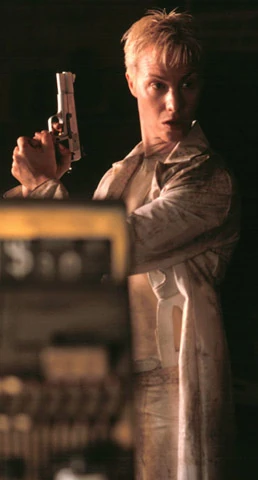
After the Wachowskis proved their chops with Bound, they got The Matrix green-lit. Say what you will about the whole trilogy, but The Matrix was a tremendous film. There are a million little Easter eggs and puzzles in The Matrix, but the one I love the most is Switch. Remember her? She is the member of Morpheus's crew who helps to wake up Neo, and she's notable for being one of only a handful of redpill characters in the entire trilogy who wears white.
She's also totally queer. It never overtly comes up in The Matrix, but just look at her. In fact, the original story treatments portrayed Switch as a male character in the real world, but female when her personality substantiated in the fantasy world of The Matrix. In the final film, of course, Switch is a female both in and out of The Matrix, but she retains an undeniable androgynous/LGBT presence.
I love Switch because she is badass, queer, brave, and loyal. Unfortunately, she's a supporting character who gets killed in a terrible way, and her defiance in the face of her doom is heartbreaking. She's one of my favorite LGBT characters in science fiction, but we lost her too soon.
Another minor LGBT character in The Matrix trilogy pops up in the final film, Matrix Revolutions (did you even see it? I honestly wouldn't blame you if you didn't). Again, her sexuality is never explicitly addressed and it doesn't even matter, but anyone with even a blip of gaydar can tell that Charra, one of Zion's volunteer dock defenders in the real world, is totally a dyke. She's such a bit part that there's not really much to say other than to point out the fact that her minor role is why the Wachowskis are so great with LGBT representation. Charra just sort of shows up randomly, does some cool things that are brave and maybe a little foolhardy, and, well, meets an untimely end, like many of the human soldiers in the final Matrix installment. It's the fact that she's kind of an unremarkable denizen of the Wachowskis' universe that makes their LGBT inclusion so remarkable.
V for Vendetta came next, and the Wachowskis continued to work with source material that depends heavily upon LGBT concepts. Through a series of flashbacks, we see how the anarchist terrorist, V, is inspired to overthrow the fascist regime after learning the life story of a lesbian, one of V's fellow prisoners, and how she is arrested, put in a concentration camp, and is tortured because of her love for another woman. The lesbian characters are truly at the heart of the film, and injustice against gay people is portrayed as one of the cruelest forms of inhumanity. V teaches us that love and beauty--no matter their form--make us human, and when society turns against them, their protection is worth sacrificing everything. Love it.
[We are all going to pretend that Speed Racer never happened. LALALALALALALALALALALA I CAN'T HEAR YOU.]
[Moving on.]
Cloud Atlas came out in 2012, and was an adaptation of a gloriously tiered Baroque wedding cake of a novel. I really recommend reading the novel; its narrative construction is just so magnificent and exhilarating, and it's just not possible to accurately portray it on screen. Nevertheless, I loved how the Wachowskis played with the idea of souls or personalities floating across time, cloaked in different colors of skin and differently shaped eyes and different genders and sexualities. But our humanity is not any of those things, and regardless of superficialities like race and sex, we are always facing the same opportunities to make things right, with the irrepressible human urge to create always being the key to finding ourselves. Cloud Atlas has overtly gay male characters, but again, they're sort of unremarkable against the sweeping Big Ideas that propel the Cloud Atlas narrative.
Jupiter Ascending, the most recent Wachowski film, doesn't really have any big ideas, alas. But it has Eddie Redmayne as a deliciously campy villain who is super-gay. I know, I know, another mincing and ridiculously overwrought gay villain, but at least he doesn't rape-murder anyone like my buddy Baron Harkonnen. And if it's going to be done, Redmayne and the Wachowskis are the ones to do it.
I fucking love him. He's serving us evil space Liberace realness.
Also, what could possibly be gayer than Channing Tatum, as a werewolfy-elf soldier thing, gratuitously taking off his shirt to fight a bunch of bad guys? ...Oh, nevermind. This is way gayer.
So there you have it: my exegesis on why the Wachowskis' oeuvre is the best thing to happen to LGBT people in science fiction film, and why The Telegraph's reference to V for Vendetta was accurate but maybe a little underinclusive. Still, as much as they have done and as much as I love the Wachowskis' work, they have not (yet?) offered a gay heroic science fiction lead character.
This post is already too long, but I have to include, as just a final thought, Lana Wachowski's acceptance speech at the 2012 HRC Awards when Cloud Atlas was coming out. It's long, but it is hugely important to me as a gay fan of her and her brother and their films.
So it's been out a couple of weeks, but I finally had a chance to read Star Wars: Before The Awakening. Currently, it's Amazon's #1 New Release in Children's Science Fiction Books.
... Shut up. I like reading young reader books. They make me feel super smart.
Anyway, this book is a nice little collection of three short stories, one each for Finn, Rey, and Poe. As expected, it's an easy quick read (for an adult *cough*) and well worth it.
Finn's story has a lot of scenes involving Phasma, and she just oozes that gleaming, faceless ruthlessness that Gwendolyn Christie so would have nailed if she'd been in TFA for more than a few moments.
In addition, the short story introduces us to the other members of Finn's Stormtrooper fire-team. For example, the hapless FN-2003, or Slip, is the Stormtrooper that Poe expertly snipes during the opening raid sequence on Jakku, and who leaves his bloody hand print on Finn's helmet. Knowing more about the relationship between Finn and Slip definitely adds dimension to Finn's crisis of consciousness during the Jakku raid. If Finn only knew who killed Slip, the Stormpilot ship might enter some treacherous waters...
Also, the Internet is abuzz with the compelling theory that fan-favorite TR-8R is another one of Finn's former team members.
And again, reading Before The Awakening will certainly deepen the impact of this scene. [TR-8R is Nines, confirmed on starwars.com the same day as this post.]
Rey's story was really atmospheric and well-written, but it provides zero insight into her backstory. There's nothing about the x-wing pilot doll, who dropped her on Jakku, or any other tidbit that offers any clue about her mysterious past. Still, worth a look.
The centerpiece of the collection is Poe's story, and I'm not just saying that because I'm a fanboy. It has a good amount of character backstory, and I mean all the way back, like to his parents on Yavin 4 after the Battle of Endor. It turns out that he is just a Poe boy from a Poe family.
The story includes multiple well-written zero-gravity dog fighting sequences, and of course, a few "D'aaawwww" BB-8 moments. It follows Poe as his resourcefulness and dedication expose a conspiracy, which ultimately leads up to the moment of Poe receiving his mission to locate Lor San Tekka from Princess General You-Know-Who. It's a great tie-in to the film and really fun to read.
I can I assure you, I was scrutinizing every word for some clue to Poe's sexual poe-clivities, straight or gay, but no dice. I was looking so closely, in fact, that one passage in particular, taken totally out of context, made me giggle:
Leia was looking up at Poe, smiling ever so slightly. “Flyboys. You’re all the same.”
“Some of us are flygirls,” Poe said.
*SNAPS* OOOOOOO GIRL! Or should I say: FLY GIRL?
That's right, In Living Color, bitchez.
But seriously, Poe is portrayed throughout the story as a consummate professional and treats his fellow pilots and Resistance colleagues of both genders with respect, warmth, and camaraderie. Other than him acting like an all-around awesome guy, there's nothing overt to go on here.
Bottom line: Looking for some satisfying but fluffy reading for your weekend? Pick up or download this book. But don't expect any revelations other than "Wow, Poe really is that dreamy."
Obviously, I've been thinking a lot about why it matters to me that Poe could be a central and heroic LGBT character in the Star Wars universe. Why should a gay guy who grew up in the 1980's care so much about finally seeing a positive and courageous cinematic role model for gay science fiction geeks? The answer basically comes down to this asshole:
Fucking Baron Vladimir Harkonnen from Dune.
Specifically, the portrayal of Baron Harkonnen in the 1984 David Lynch adaptation, in all its grotesquely homosexual and homicidal horror.
First, let me just acknowledge that Frank Herbert's Dune is a monumental achievement in science fiction literature. The text is clear that its chief antagonist, Baron Harkonnen, is gay. And because the book came out in 1965, very pre-Stonewall, it's not particularly surprising that a gay villain is portrayed as a conniving sadist. It's perfectly consistent with the prevailing binary tropes of gay male characters being either effeminate clowns or dangerous sociopaths.
Second, please don't mistake me: I love David Lynch. It's impossible to overstate how hard Twin Peaks rocked my world. Mulholland Drive is easily one of my all-timefavorite films. I even kind of enjoyed the delirious lunacy of Lynch's Dune adaptation when I later revisited it on videotape--Patrick Stewart and Kyle MacLachlan were great, the Bene Gesserit were darkly fabulous, and Sting made me feel that intoxicating combination of excited and scared. You know what I'm talking about.
Did I mention that Sting was effing glorious?
But here's the problem. The year is 1988. I am solidly in my mid-teens, definitely past puberty and secretly (so secretly) aware that I'm gay. By then, everything about my imagination and personality has been shaped by Star Wars and my passion for all things space and science fiction. Lynch's Dune, which flopped in theaters in 1984, has been horribly adapted for a televised mini-series event.For whatever reason, that televised versioncomes on at my grandparents' house. I can't imagine why they are letting us watch it--my grandmother was a seriously devout member of an extremely insular Christian church in rural Ohio and anything not-the-Bible was just confusing to her. My grandpa didn't care so much about the church, so maybe he was watching it? I don't know. In any event, this bullshit pops up on their TV:
I mean. WHAT. THE. ACTUAL. FUCK. My first instinct, as this is airing in my ultra-conservative grandparents' TV room in the depths of 1988, was mortified panic. How was I supposed to outwardly react? Like all closeted kids, I was an expert at maintaining a poker face or, if pressed, making a homophobic comment when something seemed too gay. But what response could sufficiently camouflage my own gayness in such confusing and disgusting circumstances? I was at an utter loss. I was so flustered that I simply left the room. But the inner conflict I experienced was far more haunting. I knew I wanted to be with boys, and I knew I loved science fiction. But as far as I knew in 1988, this scene was the only way I had ever seen those two dimensions of my personality reconciled on-screen. And it was full of gag-worthy pustule drainage and fear and victimization and bloody rape-murder. Was that about me? This scene could easily disturb any kid--but a confused and lonely gay teen? It seriously wrecked me. It would easily be another decade before less rapey and murdery gay characters would start appearing in pop culture, but not usually in science fiction and certainly not as protagonists. In very real ways, the specter of Baron Harkonnen has been casting his corpulent shadow over my perception of what it means to be gay in a science fiction movie for nearly 30 years. Then, Poe Dameron shows up, and he is the exact polar opposite of Baron Harkonnen. He's loyal, funny, dignified, passionate, charismatic, and courageous. Gay kids could see all those things in someone they can closely identify with, instead of just seeing detestable villains or, worse, cowering victims whose only future is to get their hearts (literally) ripped out. Could Poe be the hero we are looking for, who can save science fiction films from a century of toxic cinematic stereotypes of gay people? It's a lot to ask, but I am dying to see him try.
I thought I was being all clever and cute when I thought up Poemosexual, but a quick search proved that--once again--people on the Internet are always more clever and cute than I'll ever be.
Seems like a lot of people reference or hashtag "poemosexual" in reference to either poetry, or less frequently, Edgar Allen Poe. But those brainiacs are doing it wrong. Obviously, it's much more hilarious and timely to use it in reference to the Poe-tential (it's only going to get worse, buckle in) that Poe Dameron is gay--or more commonly, in reference to shipping Poe and Finn.
A search for poemosexual on Twitter shows that poemosexual was first used in reference to Poe's sexuality on opening day, 12/18, in a Tweet by user @twelvicity in response to this fan art:
There have only been a handful of the poemosexual hashtag on Twitter since then.
Meanwhile, over on the Instagrams, I could only find one posting. I fully support and endorse @chrispan91 and his proclamation of his poemosexuality.
By now, Poemos are literally Poe-ing out of the woodwork--as of this entry, there are over 700 slash fic entries in the Archive Of Our Own.
!!!!
Time to start reading--and to start hashtagging "poemosexual" with wild abandon!
Here is the Ellen interview with the three leads right before TFA opened in December, 2015. At about 2:12, Ellen asks if there's any romance between any of their characters, and Oscar Isaac's response is... well, see for yourself.
Building on the hype, this Hypable article by Natalie Fisher thoughtfully dissects the film's innuendo and what it might mean to have a gay central character in the franchise. I was surprised to learn that she is a newcomer to the fandom because she definitely captured the gravity of the possibility and what it would mean to fans new and old.
The Telegraph picked up this story in an excellent feature by Helen O'Hara a week later. It talks a little more about the practicalities at stake regarding global release and Darth Mouse's financial risks. Good read.
Great, now that the homework is out of the way, let's get to trolling the Internet for more!