Poe Dameron: Dashing Resistance operative. One hell of a pilot. LGBT cinematic icon?
I'm a gay Star Wars fan, and this blog is my effort to collect and contribute to musings about LGBT characters in sci-fi, geek culture, and beyond. Welcome!
As you might know, the Bechdel test was developed in the 1980's as a way of assessing a film's treatment of its female characters. To pass the Bechdel test, a movie must have at least two female characters (preferably named) who have a conversation about something other than a male. This seems like a really low bar, but only a small handful of major studio films pass every year. Basically, the Bechdel test shows us that mainstream films continue to hew to a long misogynist tradition in popular culture to marginalize the female experience.
Since Poemosexuality has become a thing, I've been thinking a lot about gay characters in media, and specifically in sci-fi/action films--and whether anyone tracks the treatment of LGBT characters along criteria like those of the Bechdel test.
I discovered that GLAAD does an annual Studio Responsibility Index (SRI), which surveys and inventories major film studio releases. For purposes of the SRI, GLAAD groups films into 5 categories: comedy, genre (sci-fi, action, and fantasy), animated/family, drama, and documentary. The SRI then identifies as "inclusive" any film that has LGBT characters of any stripe, major or minor. Next, as part of their evaluation, GLAAD applies the Vito Russo test, inspired by the Bechdel test, to assess an inclusive film's treatment of its gay character(s). Under this standard, a movie includes a meaningful LGBT character if the following are true:
The film contains a character that is identifiably LGBT.
That character must not be predominantly defined by their sexual orientation or gender identity. This refers to the depth of the character: flimsy two-dimensional stereotypes vs. actual characters who have personality and attributes beyond just their gayness.
The LGBT character plays a meaningful role in the narrative. In other words, the character is not window dressing to provide commentary or situational humor, like gross-out or gay-panic jokes. Rather, the character must be significant enough to the plot that the character's removal would noticeably alter the story.
I was gratified to see that the gay characters in Cloud Atlas passed the Vito Russo test a few years ago. I know that the Wachowskis' films have not been great since The Matrix, but at least they're doing LGBT representation in film right!
Aside from that, the 2015 SRI, which reviewed films released in 2014, reveals what I've been bitching about all along:
Other than documentaries, genre films had by far the lowest percentage of inclusive films out of the other categories: just 6.5%, which means that only 3 out of 46 genre films released in 2014 had LGBT characters in them at all. And it's not getting better. In 2013, GLAAD counted 43 major release films in the sci-fi/fantasy genre, and 4 (or 9.3%) had LGBT characters.
It's not so easy to discern from GLAAD's summary exactly which 2014 films it counted as the 3 inclusive genre films. (Maybe Exodus: Gods and Kings? ...Not sure what the others were.) But as far as I can tell, no sci-fi films passed GLAAD's Vito Russo test in 2014. That means there were zero characters of substance in any major studio sci-fi film the entire year. Zero.
[gratuitous fan art]
I understand that people might dispute whether Oscar Isaac's lip bite and his other acting choices are enough to substantiate Poe's character as canonically gay. What I don't get is people who think that LGBT representation in modern pop culture is just fine, and that we gay fans are somehow being too greedy in wishing/hoping that Poe is gay, and that we should just be satisfied with comedies and dreary awards-focused dramas that include LGBT characters. But as the surge of the Poemosexual Agenda has demonstrated, we fans of sci-fi/fantasy in general and Star Wars in particular are clearly not satisfied that there are no LGBT protagonists in a major studio genre film.
I really want the first to be Poe, because Star Wars has been my jam since 1977 and it would mean the galaxy to me as a gay fan to be able to say that Star Wars broke that ground. If he was just "identifiably gay" in a way that didn't rely purely on innuendo or code, he would clearly satisfy the other two criteria of the Vito Russo test, and we would have our first heroic LGBT protagonist in a major studio sci-fi/fantasy film.
Remember when I went on and on about the Wachowskis and rhapsodized about how much their films mean to me as a gay science fiction fan? Jupiter Ascending managed to sweep up a bunch of Razzie nominations last week: Worst Actor (Channing Tatum), Worst Supporting Actor (Eddie Redmayne), Worst Actress (Mila Kunis), Worst Directors, Worst Picture, and Worst Screenplay. Holy Wach-OUCH-skis! That's pretty bad, although I submit that Kunis and Tatum should have also been nominated for Worst Screen Combo. Seriously, there's more chemistry involved in paint drying than between those two.
"A Razzie? Well fuck you very much."
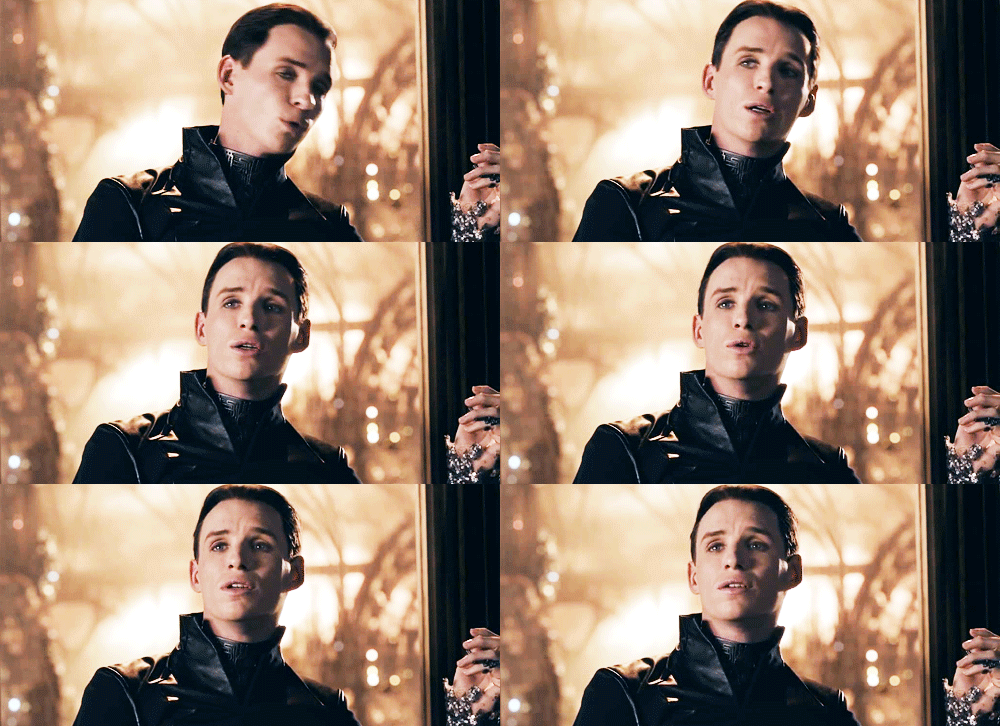
I do take issue with Eddie Redmayne being a "worst" actor. In 1977, Sir Alec Guiness delivered with commitment, style, and charisma stultifying dialogue like "He feared you might follow old Obi-Wan on some damn fool idealistic crusade like your father did," and "Now, that's a name I've not heard in a long time... A long time." And he was nominated for an Oscar for BEST supporting actor in Star Wars. (Peter Cushing and other actors of that generation were the same: it didn't matter if they were in the cheesiest science fiction schlock acting on sets with paper mache boulders. Every line was delivered with the same care and drama as if it were Shakespeare.) Redmayne did the same thing in Jupiter Ascending. Sure, he spent much of the movie flying into inexplicable rages, posing and hissing and sparkling like a drag queen who is just done with your bullshit. And maybe the reason so much of the final cut's set pieces were digital was because Redmayne chewed up and swallowed all of the original scenery. But I thought he did an amaaaaazing job with the material (and co-stars) he had to work with--he vogued and camped and shrieked his way right into my gaysci-fi fanboy heart. I was genuinely rooting for him by the end of the movie.
Ah well. The good news is that I may get to see Jupiter Ascending again during our annual Razzie viewing party... so, silver lining.
The Telegraph's Poe article noted the absence of gay characters in action films with the exceptions of gay characters in The Mortal Instruments: City of Bones and V for Vendetta. And I have thoughts.
First, to be honest, I don't know a thing about The Mortal Instruments YA series. I've seen bits of the movie and it didn't seem great, and the books don't particularly interest me. So I will take The Telegraph's word for it and cheer from afar for some bad-ass gay characters in The Mortal Instruments. Yay.
What does interest me, however, is the name drop of V for Vendetta, originally a graphic novel by Alan Moore that was adapted by the Wachowskis into a film. Seriously, I am a HUUUUGE Wachowski fanboy. HUGE. And I am a zealous and blindly faithful Wachowski fanboy precisely because the Wachowskis have been incorporating LGBT characters and queer themes into action and science fiction films for nearly twenty years--something I can't say for any of my other favorite fandoms, including Star Wars (...or can I?). If you blinked and missed the other awesome LGBT-positive characters in Wachowski films, here's your crash course in why the Wachowskis are my LGBT science fiction heroes.
Bound for glory
First, I cannot talk about the Wachowskis without first talking about Bound, which turns 20 years old this year. True, Bound is a noir crime film and not science fiction, but if you want to understand the Wachowskis' science fiction projects, you have to start with Bound. It's about two women, played brilliantly by Gina Gershon and Jennifer Tilly, who fall desperately in love and concoct an elaborate scheme to rob a dangerous mobster. It all goes south, of course, and you spend the second half of the film gnawing your nails to the quick and rooting for the coolest, cleverest, and most resourceful lesbian characters you will likely ever encounter. If you have even the slightest interest in LGBT film and you haven't seen Bound... well, first of all, what is wrong with you? Second, after reflecting very carefully on your life choices, watch Bound immediately. You are welcome.
Oh hey, I forgot that Christopher Meloni is one of the mobster thugs in Bound. You are welcome again.
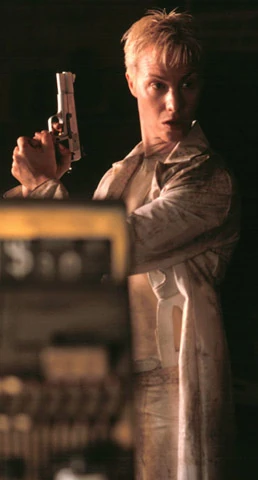
After the Wachowskis proved their chops with Bound, they got The Matrix green-lit. Say what you will about the whole trilogy, but The Matrix was a tremendous film. There are a million little Easter eggs and puzzles in The Matrix, but the one I love the most is Switch. Remember her? She is the member of Morpheus's crew who helps to wake up Neo, and she's notable for being one of only a handful of redpill characters in the entire trilogy who wears white.
She's also totally queer. It never overtly comes up in The Matrix, but just look at her. In fact, the original story treatments portrayed Switch as a male character in the real world, but female when her personality substantiated in the fantasy world of The Matrix. In the final film, of course, Switch is a female both in and out of The Matrix, but she retains an undeniable androgynous/LGBT presence.
I love Switch because she is badass, queer, brave, and loyal. Unfortunately, she's a supporting character who gets killed in a terrible way, and her defiance in the face of her doom is heartbreaking. She's one of my favorite LGBT characters in science fiction, but we lost her too soon.
Another minor LGBT character in The Matrix trilogy pops up in the final film, Matrix Revolutions (did you even see it? I honestly wouldn't blame you if you didn't). Again, her sexuality is never explicitly addressed and it doesn't even matter, but anyone with even a blip of gaydar can tell that Charra, one of Zion's volunteer dock defenders in the real world, is totally a dyke. She's such a bit part that there's not really much to say other than to point out the fact that her minor role is why the Wachowskis are so great with LGBT representation. Charra just sort of shows up randomly, does some cool things that are brave and maybe a little foolhardy, and, well, meets an untimely end, like many of the human soldiers in the final Matrix installment. It's the fact that she's kind of an unremarkable denizen of the Wachowskis' universe that makes their LGBT inclusion so remarkable.
V for Vendetta came next, and the Wachowskis continued to work with source material that depends heavily upon LGBT concepts. Through a series of flashbacks, we see how the anarchist terrorist, V, is inspired to overthrow the fascist regime after learning the life story of a lesbian, one of V's fellow prisoners, and how she is arrested, put in a concentration camp, and is tortured because of her love for another woman. The lesbian characters are truly at the heart of the film, and injustice against gay people is portrayed as one of the cruelest forms of inhumanity. V teaches us that love and beauty--no matter their form--make us human, and when society turns against them, their protection is worth sacrificing everything. Love it.
[We are all going to pretend that Speed Racer never happened. LALALALALALALALALALALA I CAN'T HEAR YOU.]
[Moving on.]
Cloud Atlas came out in 2012, and was an adaptation of a gloriously tiered Baroque wedding cake of a novel. I really recommend reading the novel; its narrative construction is just so magnificent and exhilarating, and it's just not possible to accurately portray it on screen. Nevertheless, I loved how the Wachowskis played with the idea of souls or personalities floating across time, cloaked in different colors of skin and differently shaped eyes and different genders and sexualities. But our humanity is not any of those things, and regardless of superficialities like race and sex, we are always facing the same opportunities to make things right, with the irrepressible human urge to create always being the key to finding ourselves. Cloud Atlas has overtly gay male characters, but again, they're sort of unremarkable against the sweeping Big Ideas that propel the Cloud Atlas narrative.
Jupiter Ascending, the most recent Wachowski film, doesn't really have any big ideas, alas. But it has Eddie Redmayne as a deliciously campy villain who is super-gay. I know, I know, another mincing and ridiculously overwrought gay villain, but at least he doesn't rape-murder anyone like my buddy Baron Harkonnen. And if it's going to be done, Redmayne and the Wachowskis are the ones to do it.
I fucking love him. He's serving us evil space Liberace realness.
Also, what could possibly be gayer than Channing Tatum, as a werewolfy-elf soldier thing, gratuitously taking off his shirt to fight a bunch of bad guys? ...Oh, nevermind. This is way gayer.
So there you have it: my exegesis on why the Wachowskis' oeuvre is the best thing to happen to LGBT people in science fiction film, and why The Telegraph's reference to V for Vendetta was accurate but maybe a little underinclusive. Still, as much as they have done and as much as I love the Wachowskis' work, they have not (yet?) offered a gay heroic science fiction lead character.
This post is already too long, but I have to include, as just a final thought, Lana Wachowski's acceptance speech at the 2012 HRC Awards when Cloud Atlas was coming out. It's long, but it is hugely important to me as a gay fan of her and her brother and their films.